|
|
|
|



VINCENT
P. CRAWFORD
My positions are Drummond Professor of Political Economy Emeritus and Honorary Senior Research Fellow, Department of Economics, University of Oxford; Emeritus Fellow of All Souls College; and Distinguished Professor Emeritus and Research Professor, Department of Economics, University of California, San Diego.
Wikipedia page
My main contacts
(email is monitored
year-round in all three
places):
Department
of Economics
University
of California, San
Diego
9500 Gilman Drive
La Jolla, CA
92093-0508
USA
+1-302-729-3230 (Google
Voice: rings US numbers, or you can text it or leave a
voicemail if I don't pick up and it will send me an email
alert)
email: v2crawford "at" ucsd.edu
Oxford OX1 4AL
United Kingdom
+44-1865-279339 study direct (can leave UK
voicemail which will reach me even if I am elsewhere)
+44-1865-279379 All Souls Lodge
email: vincent.crawford "at"
economics.ox.ac.uk
Department of
Economics
University of Oxford
Manor Road Building
Manor Road
email: vincent.crawford
"at"
economics.ox.ac.uk
Upcoming events:
Virtual Seminar in Economic Theory, Thursday, April 18, 4 p.m. UK time; Paper and slides
Semi-plenary lecture, International Conference on Public Economic Theory, Lyon, France, June 2024; Paper and slides
Plenary Lecture, Conference on Mechanism and Institution Design, Budapest, Hungary, July 2024
Lecture Series (2) on Behavioral Game Theory and seminar (seminar paper and slides), 1st Summer School in Experimental and Behavioral Economics, by the European Economic Review, Rethymno, Crete, August 2024 (co-taught with Michalis Drouvelis, Uri Gneezy, John List, and Dana Suskind)
2003 photo
by Zoe
Crawford
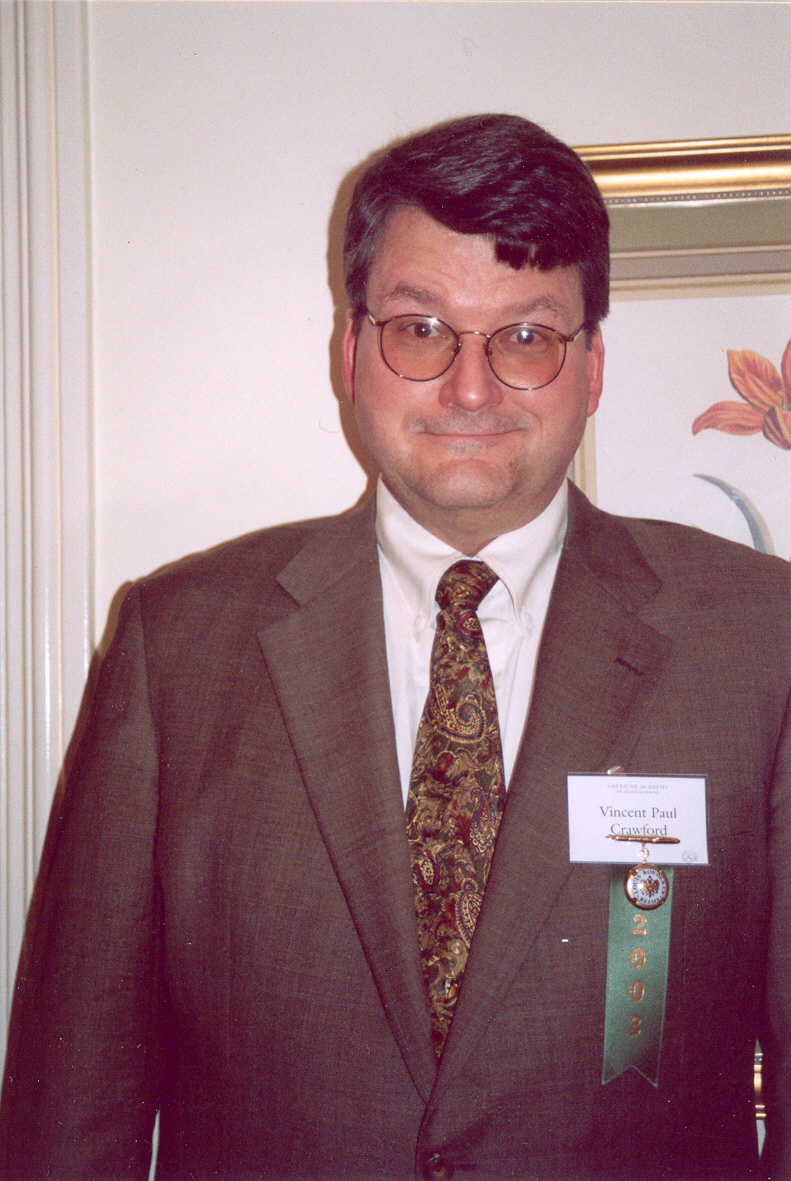

Photos by Zoe
Crawford from the 2003
Induction Ceremony at the American Academy of Arts and
Sciences
- Al and Lloyd
- Al and Vince
- Vince
and Martin Dufwenberg (in the peanut
gallery)
1999
photos
by Dorothy Hahn
Behavioral and experimental economics and game theory
Laura Blow and Vincent P. Crawford, "Meaningful Theorems: Nonparametric Analysis of Reference-dependent Preferences," revised 24 November 2023; Online Appendices A-D; Lecture slides
(Corrects errors in the previous version, as explained in the revised version.)
Previous version:
Laura Blow, Ian Crawford, and Vincent P. Crawford, "Meaningful Theorems: Nonparametric Analysis of Reference-dependent Preferences," 19 January 2022; Online Appendices (A to E)
Vincent P. Crawford, Miao Jin, Juanjuan Meng, and Lan Yao, "Expectations-based Reference-Dependence and Labor Supply:
Eliciting Cabdrivers’ Expectations in the Field," 5 March 2024
Vincent P. Crawford, "Efficient Mechanisms for Level-k Bilateral Trading", Games and Economic Behavior 127 (2021), 80-101
Link to final accepted version (if the above link is gated for you)
First complete version 18 April 2015, Vincent P. Crawford, "Efficient
Mechanisms
for Level-k
Bilateral Trading" slides
Presented as a John
von Neumann Distinguished Lecture at Brown
University's 250th Anniversary Symposium, May 2015
Poster
Video
Panel
discussion/Sweat box session with Mark
Satterthwaite and Brown graduate students
Also presented as the Economic
Journal Lecture, Royal Economic Society
Conference, London, April 2011; and a PER
Distinguished Lecture, Columbia University,
April 2018
Vincent P. Crawford, "Experiments on Cognition, Communication, Coordination, and Cooperation in Relationships", Annual Review of Economics 11 (2019), 167-191; direct link to published version
Vincent P. Crawford, "Modeling Strategic Communication: From Rendezvous and Reassurance to Trickery and Puffery", Nancy L. Schwartz Memorial Lecture, April 2017 (see also slides at Schwartz website)
Vincent P. Crawford, "Deceived while Rational? Game-theoretic Models of Deception and Gullibility", slides for a talk based in part on my 2017 Nancy L. Schwartz Memorial Lecture, given at All Souls College, 27 May 2019 and the Oxford Economics Society, 4 March 2020
Vincent P. Crawford, "New Directions for Modelling Strategic Behavior: Game-theoretic Models of Communication, Coordination, and Cooperation in Economic Relationships," Journal of Economic Perspectives 30(4), Fall 2016, 131–150.
Vincent P. Crawford, "Let's Talk It Over: Coordination Via Preplay Communication With Level-k Thinking," Research in Economics 71 (March 2017), 20-31. Presented as a plenary lecture at the 26th Arne Ryde Symposium,"Communication in Games and Experiments," 24-25 August 2007, Lund, Sweden; (Lecture Slides,
Vincent P. Crawford, "A Comment on
'How Portable is Level-0 Behavior? A Test of Level-k
Theory in Games with Non-neutral Frames' by Heap,
Rojo-Arjona, and Sugden"
Superseded
by Vincent
P. Crawford,
"'Fatal
Attraction' and Level-k Thinking in
Games with Non-neutral Frames,"
Journal of Economic
Behavior and Organization 156 (2018),
219-224
Vincent P. Crawford, "Boundedly
Rational versus
Optimization-Based Models of
Strategic Thinking and Learning
in Games,
Michèle Belot, Vincent P. Crawford, and Cecilia
Heyes,
Vincent P.
Crawford and Juanjuan Meng, "New
York City Cabdrivers' Labor Supply Revisited:
Reference-Dependent Preferences with
Rational-Expectations Targets for Hours and Income," American
Economic Review 101
(August 2011), 1912-1932. Better version of Figure 1.
Final version of web appendix,
June 2010.
Web
appendix: "Limiting
LQRE as a Model of Limiting Outcomes in Van Huyck,
Battalio, and Beil’s Coordination Games"
Vincent
P. Crawford, Tamar Kugler, Zvika Neeman, and Ady Pauzner, "Behaviorally
Optimal Auction Design: An Example and Some
Observations," Journal of the
European Economic Association 7 (2009), 377-387.
Vincent
Crawford, Uri Gneezy,
and Yuval Rottenstreich,
"The
Power of Focal Points is Limited: Even Minute Payoff
Asymmetry May Yield Large Coordination Failures," American
Economic Review 98 (2008), 1443-1458; Web
Appendix
Reference
(without
screen
credit,
and
with
no
real
appreciation
of
the
importance
of
level-k
thinking...)
on
2005
episode
of
the
CBS
series Numb3rs, "Assassin," first aired 10/21/2005 (courtesy
of William Nguyen Phan; YouTube Clip;
Text; Moriarti Comment)
Charlie:
Hide and seek.
Don:
What
are you talking about, like the kids' version?
Charlie:
A
mathematical
approach
to
it,
yes.
See,
the
assassin
must
hide
in
order
to
accomplish
his
goal,
we
must
seek
and find the assassin before he achieves that goal.
Megan:
Ah, behavioral game theory, yeah, we studied this at
Charlie:
I
doubt
you
studied
it
the
way
that
Rubinstein,
Tversky
and
Heller
studied
two
person
constant
sum
hide
and
seek with unique mixed strategy equilibria.
Megan:
No, not quite that way.
Don:
Just
bear with him.
Thoughts
on Hide and Seek games played on naturally occuring
"landscapes" from Edgar Allan Poe's The Purloined Letter
(complete
story)
General
principles:
"…But
he
perpetually
errs by being too deep or too shallow, for the matter in hand;
and many a schoolboy is a better reasoner than he. I knew one
about eight years of age, whose success at guessing in the
game of 'even and odd' attracted universal admiration. This
game is simple, and is played with marbles. One player holds
in his hand a number of these toys, and demands of another
whether that number is even or odd. If the guess is right, the
guesser wins one; if wrong, he loses one. The boy to whom I
allude won all the marbles of the school. Of course he had
some principle of guessing; and this lay in mere observation
and admeasurement of the astuteness of his opponents. For
example, an arrant simpleton is his opponent, and, holding up
his closed hand, asks, 'are they even or odd?' Our schoolboy
replies, 'odd,' and loses; but upon the second trial he wins,
for he then says to himself, the simpleton had them even upon
the first trial, and his amount of cunning is just sufficient
to make him have them odd upon the second; I will therefore
guess odd'; --he guesses odd, and wins. Now, with a simpleton
a degree above the first, he would have reasoned thus: 'This
fellow finds that in the first instance I guessed odd, and, in
the second, he will propose to himself upon the first impulse,
a simple variation from even to odd, as did the first
simpleton; but then a second thought will suggest that this is
too simple a variation, and finally he will decide upon
putting it even as before. I will therefore guess even'
guesses even, and wins. Now this mode of reasoning in the
schoolboy, whom his fellows termed 'lucky,' --what, in its
last analysis, is it?"
"It
is
merely,"
I said, "an identification of the reasoner's intellect with
that of his opponent."
(glossary:
"arrant
simpleton"
=
L1
(conditional
on
shared
history,
which
makes
one
choice
focal
in
a
way
that
would
attract
L0);
"simpleton a degree above the first" = L2; boy with all the
marbles = L2 or L3, depending on his assessment of how simple
his opponent is)
Specific
application:
"At
length
my
eyes, in going the circuit of the room, fell upon a trumpery
filigree card-rack of pasteboard, that hung dangling by a
dirty blue ribbon, from a little brass knob just beneath the
middle of the mantelpiece. In this rack, which had three or
four compartments, were five or six visiting cards and a
solitary letter. This last was much soiled and crumpled. It
was torn nearly in two, across the middle --as if a design, in
the first instance, to tear it entirely up as worthless, had
been altered, or stayed, in the second. It had a large black
seal, bearing the D-- cipher very conspicuously, and was
addressed, in a diminutive female hand, to D--, the minister,
himself. It was thrust carelessly, and even, as it seemed,
contemptuously, into one of the upper divisions of the rack.
"No
sooner
had
I glanced at this letter, than I concluded it to be that of
which I was in search. To be sure, it was, to all appearance,
radically different from the one of which the Prefect had read
us so minute a description. Here the seal was large and black,
with the D-- cipher; there it was small and red, with the
ducal arms of the S-- family. Here, the address, to the
Minister, was diminutive and feminine; there the
superscription, to a certain royal personage, was markedly
bold and decided; the size alone formed a point of
correspondence. But, then, the radicalness of these
differences, which was excessive; the dirt; the soiled and
torn condition of the paper, so inconsistent with the true
methodical habits of D--, and so suggestive of a design to
delude the beholder into an idea of the worthlessness of the
document; these things, together with the hyperobtrusive
situation of this document, full in the view of every visitor,
and thus exactly in accordance with the conclusions to which I
had previously arrived; these things, I say, were strongly
corroborative of suspicion, in one who came with the intention
to suspect."
Miguel
A. Costa-Gomes and Vincent P. Crawford, "Studying Cognition via Information Search in
Two-Person Guessing Game Experiments," paper still
in progress.
Lecture Slides, Berkeley Psychology
and Economics Seminar, 6 March 2007, and the Barcelona JOCS
Seminar, 26 March 2007; focusing on cognitive and
experimental issues; earlier version of Lecture Slides,
Chicago, 2007, AEA Meetings; focusing on cognitive and
experimental issues
Lecture Slides, Workshop on
Econometrics and Experimental Economics,
Lecture Slides, "Studying Strategic
Thinking by Monitoring Search for Hidden Payoff Information
and Interpreting the Data in the Light of Algorithms that
Link Cognition, Search, and Decisions," NSF Workshop on
"Behavior, Computation, and Networks in Human Subject
Experimentation," Del Mar, California, July 31-August 1,
2008
Lecture Slides, Cemmap/ELSE
Workshop on "Experimental Analysis of Procedural Rationality
in Games and Decisions,"
Lecture Slides, "Studying Strategic
Thinking Experimentally by Monitoring Search for Hidden
Payoff Information," Behavioral, Social and Computer
Sciences Seminar, Calit2, University of
Vincent P.
Crawford, "Look-ups as the
Windows of the Strategic Soul: Studying Cognition
via Information Search in Game Experiments" (based on joint
work with Miguel
A.
Costa-Gomes and Bruno Broseta), in Andrew Caplin and Andrew
Schotter, editors, Perspectives on the Future of
Economics: Positive and Normative Foundations, Volume
1 in the series Handbooks of Economic Methodologies,
Oxford University Press, 2008
Lecture Slides
presented at the Conference on the Foundations of
Positive and Normative Economics,
Miguel
A. Costa-Gomes and Vincent P. Crawford, "Cognition
and Behavior in Two-Person Guessing Games: An
Experimental Study," American
Economic Review 96 (December 2006), 1737-1768; Web Appendix
(zip) (A. Instructions for Baseline and Robot/Trained
Subjects Treatments; B. Description of Pilots; C.
Preliminary Statistical Tests; D. Figures Showing Subjects'
Aggregate Guess Distributions, Game by Game; E. Subjects'
Guess and Look-up Data; F. Specification Tests and Analysis
of Clusters; G. Supplementary Tables; H. Analysis of
Search); Data Appendix
(zip); Lecture slides
(ppt)
Old Appendix I. Selected
Subjects' Information Searches and Types' Search
Implications
Figures showing aggregate frequency
distributions of guesses game by game (with games identified
by the codes from Table 2):
2A-B, 2C-D, 2E-F, 2G-H, 2I-J, 2K-L, 2M-N,
2O-P
Sara Robinson extensively discusses this paper in
her article, "How Real People Think
in Strategic Games," in the
January/February 2004 issue of SIAM News.
Vincent
P. Crawford, "Lying
for Strategic Advantage: Rational and Boundedly
Rational Misrepresentation of Intentions," American
Economic Review 93 (March 2003), 133-149; Lecture slides
"The truth deserves a
bodyguard of lies." -- Winston Churchill, Teheran, 1943
"The threat reporting
that we received in the Spring and Summer of 2001 was not
specific as to time, nor place, nor manner of attack. Almost
all of the reports focused on al-Qaida activities outside
the
Let me read you some
of the actual chatter that we picked up that Spring and
Summer:
• 'Unbelievable news
in coming weeks'
• 'Big event ...
there will be a very, very, very, very big uproar'
• 'There will be
attacks in the near future'
Troubling, yes. But
they don’t tell us when; they don’t tell us where; they
don’t tell us who; and they don’t tell us how."
-- Condoleeza Rice,
Opening Remarks to the National Commission on Terrorist
Attacks Upon the
My question for
Rice, Bush, Cheney, and Rumsfeld: If Al-Quaeda had
sent you a message saying "We're going to hijack
airplanes and crash them into the World Trade
Center--the one in New York City--on September 11--this
coming September 11", would you have believed them?
Vincent P. Crawford, "Introduction
to Experimental Game Theory" (Symposium issue),
Journal of Economic Theory 104 (May 2002), 1-15.
Miguel
Costa-Gomes, Vincent Crawford, and Bruno Broseta,
"Cognition
and
Behavior in Normal-Form Games: An Experimental Study," Econometrica
69 (September 2001)), 1193-1235; Correction of minor typos
in Table 2 of published version
(p.1216)
Preliminary version (UCSD Discussion Paper 98-22,
includes appendices)
extensively revised
version plus Appendix A (UCSD Discussion Paper 2000-02R)
Vincent P. Crawford, "Learning
Dynamics, Lock-in, and Equilibrium Selection in
Experimental Coordination Games," in Ugo Pagano
and Antonio Nicita, editors, The Evolution of
Economic Diversity (papers from Workshop X,
International School of Economic Research, University of
Siena), London and New York: Routledge, 2001, 133-163; Lecture slides
Readers (and
potential Routledge authors) should note that Routledge
eliminated crucial parts of Figure 6.2(b), making it
meaningless. There should be a closed dot at (2,0) and an
open dot at (0,0), as in the UCSD Discussion Paper
97-19 version linked above.
Potential authors: Routledge also doesn’t give you even the
opportunity to buy reprints.
Vincent P. Crawford
and Bruno
Broseta, "What
Price Coordination?The
Efficiency-enhancing Effect of
Auctioning the Right to Play," American
Economic Review 88 (March 1998),
198-225.
Vincent P. Crawford, "Theory
and
Experiment in the Analysis of Strategic
Interaction," in David Kreps and Ken Wallis, editors, Advances in Economics
and Econometrics: Theory and Applications, Seventh
World Congress, Vol. I, Econometric Society Monographs No. 27,
Cambridge, U.K., and New York: Cambridge University
Press, 1997, 206-242; reprinted with minor
changes and additions in Colin Camerer,
George Loewenstein, and Matthew Rabin, editors, Advances in Behavioral
Economics,
Princeton, NJ: Princeton University Press, 2003,
344-373.
Vincent P. Crawford, "A Survey
of Experiments on Communication via Cheap Talk," Journal of Economic
Theory 78
(February 1998), 286-298.
Vincent P. Crawford, "Adaptive
Dynamics
in Coordination Games," Econometrica
63 (January 1995), 103-143.
Vincent P.
Crawford, "An
'Evolutionary'
Interpretation of Van Huyck,
Battalio, and Beil's
Experimental Results on
Coordination,"
Games and Economic Behavior 3
(February 1991), 25-59.
Vincent P. Crawford,
"Explicit Communication
and Bargaining Outcomes," American Economic
Review Papers and Proceedings 80 (May 1990), 213-219.
Vincent P. Crawford, "Equilibrium
without
Independence," Journal of Economic
Theory 50 (February 1990), 127-154.
Vincent P. Crawford, "Learning
and Mixed-Strategy Equilibria in Evolutionary Games," Journal of Theoretical Biology 140 (23
October 1989), 537-550.
Vincent P. Crawford, "The
Flexible-Salary
Match: A Proposal to Increase the Salary Flexibility
of the National Resident Matching Program," Journal
of Economic Behavior and Organization 66 (2008),
149-160.
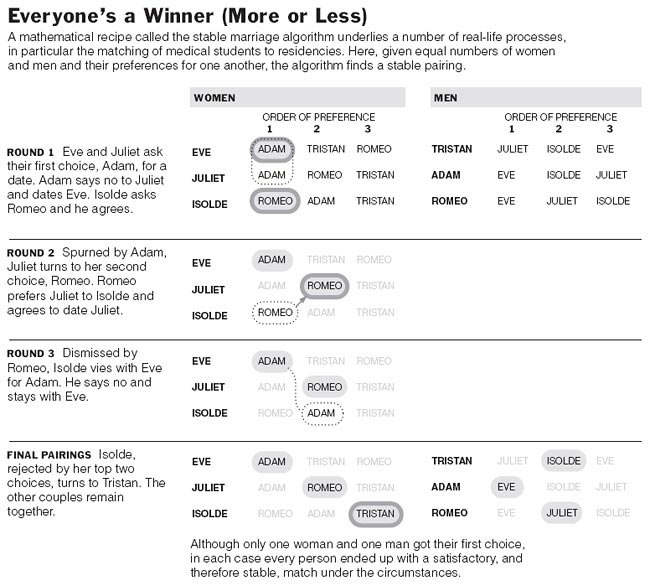
Sara Robinson's August 24, 2004 New York Times
article about the proposal, "Tweaking
the Math to Make Happier Medical Marriages" and the graphic published with the article.
Patricia
Morén's March 29, 2007 Diario Medico article about the
proposal, "La
flexibilidad
salarial del residente mejora su asignación a
distintos centros".
Vincent P. Crawford and Elsie Marie Knoer
(deceased), "Job
Matching
with Heterogeneous Firms and Workers," Econometrica
49 (March 1981), 437-450.
Alexander S. Kelso, Jr., and Vincent P. Crawford, "Job
Matching,
Coalition Formation, and Gross Substitutes," Econometrica
50 (November 1982), 1483-1504.
Vincent P. Crawford, "Comparative Statics in Matching Markets," Journal
of Economic Theory 54 (August 1991), 389-400.
"Gray Eminence?", in Eminent Economists II-Their Life Philosophies, editors Michael Szenberg and Lall Ramrattan, Cambridge University Press, 2014.
Miscellany
International
Lending, Long-Term Credit Relationships, and Dynamic
Contract Theory, Princeton Study in
International Finance No. 59, Princeton, New Jersey:
Princeton University Press,
1987
Vincent P. Crawford and Ping-Sing Kuo, "A
Dual Dutch Auction in Taipei: The Choice of
Numeraire and Auction Form in Multi-Object
Auctions with Bundling," Journal
of Economic Behavior and Organization 52 (August
2003), 427-442; Lecture slides.
"The Protestant Ethic and the
Spirit of Stuffiness" or "Who
is Gerard Wanrooy and why did he (and his boss at
Elsevier, Joop Dirkmaat), overriding JEBO
editor Barkley Rosser's decision, refuse to publish one of
these photographs in the article or to post them as
accompanying materials linked on JEBO's
website; and why did they try even to refuse us the right
to publish a link in JEBO to the
photographs posted on this website?"
Vincent
Crawford, "John Nash and
the Analysis of Strategic Behavior," Economics Letters 75 (May 2002), 377-382; UCSD Discussion Paper
2000-03; reprinted in Greek translation, with
minor changes, as "O John Nash και η ανάλυση της
στρατηγικής συμπεριφοράς," in Θεωρια Παιγνιων: Αφιερωμα
στον John Nash (Game
Theory: A Festschrift in Honor of John Nash), Constantina Kottaridi and
Gregorios Siourounis, editors, Athens: Eurasia
Publications, 2002.
Vincent P
Crawford, "Review
of Rational Ritual: Culture, Coordination, and
Common Knowledge by Michael Suk-Young Chwe," Journal of Economic Literature 40 (June 2002), 577-578;
html.
Vincent P.
Crawford, "Review
of Games of Strategy by Avinash Dixit and Susan
Skeath," Journal
of Economic Literature 39 (September 2001), 904-905; html.
Interviews, press, and
miscellaneous presentation slides
Slides
for “Information, Voting and the Quality of
Governance”, Public Panel Event to welcome Abhijit Banerjee
as Sanjaya Lall Visiting Professor at Oxford,
with a presentation by Banerjee and discussions
by Roger
Myerson and myself, moderated by
John Vickers, 19 May 2015
Video
(my part starts
about 53 minutes into the podcast,
following Myerson's which starts
about 34 minutes in; my part
refers to the above slides, which
are not visible in the video)
Vox, Center for Economic
Policy Research, August 2008 interview by
Romesh Vaitilingam on "Behavioural game theory: how real people
think in strategic interactions" (audio only)
"Συνέντευξη του Διακεκριμένου Καθηγητή του
Πανεπιστημίου της Καλιφόρνια, Σαν Ντιέγκο, Professor Vincent
P. Crawford: Στο εργαστήριο μαθαίνουμε πώς λαμβάνονται οι
αποφάσεις," Εφημερίδα ΤA ΝΕΑ 15/03/2005, ειδικό ένθετο MBA
Ανοιχτό: ("Interview of Distinguished Professor at the
University of California, San Diego, Professor Vincent P.
Crawford: In the Laboratory We Learn How Decisions are
Made", in the special inset "MBA Open" of the Greek
newspaper "The News," 15 March 2005 (interviewed by
Constantina Kottaridi (Lecturer in Economics, University of
Peloponnese) (html archive link in
Greek; doc in English
Informal talk on
"Strategies for
Getting Papers Published in Journals"
(audio only, hard to hear), National Dong Hwa
University,
Sara Robinson's August 24, 2004 New York Times article about the proposal, "Tweaking
the Math to Make Happier Medical Marriages" and the graphic
published with the article, discussing:
Vincent P. Crawford, "The
Flexible-Salary
Match: A Proposal to Increase the Salary Flexibility
of the National Resident Matching Program," Journal
of Economic Behavior and Organization 66 (2008),
149-160.
Sara Robinson's
articles
on matching markets in the April 2003
and July 2003
issues of SIAM News, discussing:
Vincent P. Crawford and Elsie Marie Knoer
(deceased), "Job
Matching
with Heterogeneous Firms and Workers," Econometrica
49 (March 1981), 437-450.
Alexander S. Kelso, Jr., and Vincent P. Crawford, "Job
Matching,
Coalition Formation, and Gross Substitutes," Econometrica
50 (November 1982), 1483-1504.
Sara Robinson’s article, "How
Real People Think in Strategic Games," in the
January/February 2004 issue of SIAM News,
discussing
Miguel A. Costa-Gomes
and Vincent P. Crawford, "Cognition
and Behavior in Two-Person Guessing Games: An
Experimental Study," American
Economic Review 96 (December 2006), 1737-1768.
Patricia Moren's 29 March 2007 Diario
Medico article about the “Flexible Salary Match
proposal, "La flexibilidad salarial
del residente mejora su asignación a distintos
centros".
Discussion of Crawford-Sobel
1982 Econometrica paper "Strategic
Information Transmission" by Jeff Ely on 1
May 2009 on Sandeep Baliga's and Jeff Ely's blog Cheap Talk.
Link to Crawford-Sobel 1982 Econometrica
paper "Strategic
Information Transmission" in 15 June 2009 guest column by Justin
Wolfers on Freakonomics
blog (link is at "cheap talk" at the very end).
Vincent
Crawford, "Modeling
Behavior in Novel Strategic Situations via
Level-k Thinking," slides for
lecture presented in the Marketing Seminar, Haas
School of Business, University of California,
Berkeley, 3 April 2008; the Applied Micro Theory
Workshop, University of Pennsylvania, 28 April 2008;
and as a “semi-plenary” lecture at GAMES 2008, Third
World Congress of the Game Theory Society, 14 July
2008.
Vincent P.
Crawford, "Level-k
Thinking," slides for
plenary lecture presented at the 2007 North American
Meeting of the Economic Science Association,
Vincent P. Crawford, Lecture Slides for "Outguessing
and Deception in Novel Strategic Situations," SESS
Distinguished Lecture, Singapore Management University,
November 2004; Lecture Slides for
version presented at Northwestern University,
October 2005.
Past Courses (only most recent year is shown for
undergraduate courses)
- Second-Year Paper on Behavioural Economics, University of Oxford. Most recently co-taught with Johannes Abeler and Séverine Toussaert (convenor); please also see their course pages. This page incorporates all relevant material from my previous course pages from 2010-18; but not all relevant material from co-teachers.
- Royal Economic Society Easter School on "Behavioural Economics", 22-25 March 2015, Brasenose College Oxford; co-taught with Colin Camerer
- Camerer slides (note the slides may have different headings than those listed here):
- Reference-dependence and loss aversion II: Applications (no further CC slides for this segment)
- Present bias and
time-inconsistency II: Applications (no CC slides posted for
this segment)
- Crawford slides:
- Strategic thinking III: Applications (much better slides; note that the slides for this part are headed "Efficient Mechanisms for Level-k Bilateral Trading")
- Procrastination
Seminar, 15 October 2014; lecture
slides
- Undergraduate Lectures on Game Theory, University of Oxford, Michaelmas Term 2014 (same as for 2013)
- Minicourse on Behavioral
Game Theory at the Asia
Summer Institute in Behavioral Economics,
- Minicourse on Strategic Thinking, University of York, June 2013
- SIRE Specialist Training Session, "Theory and Evidence on Strategic Thinking, with Applications", University of Edinburgh, 30 April 2012 (poster)
- Background:
- Supplementary Readings (part on behavioural game theory starts on p. 3)
- Lecture Series at the ECORE Summer School, European Center for Advanced Research in Economics and Statistics (ECARES). Louvain-la-Neuve, Belgium, 23-27 May 2011
- Minicourse on Behavioral Game
Theory at the Asia
Summer
Institute in Behavioral Economics,
- Undergraduate
Lectures on Behavioural and Experimental Game
Theory, University
of Oxford, Department
of Economics, Hilary Term 2011
- Lectures at the Becker-Friedman
Institute, University
of Chicago, 28 February-5 March 2011
- First
Tear MPhil Lectures on Consumer and Producer
Theory, Uncertainty, and Experimental Economics,
University of
Oxford, Department
of Economics, Michaelmas Term 2010
- Mini-Course
on Strategic Thinking, Paris
School of Economics, 17 - 19 May 2010
- Economics 200C,
Games and Information (second half; co-taught with Joel Sobel),
Spring 2009
- Economics
201C, Behavioral Game Theory (first half, co-taught with Joel Sobel),
Spring 2009
- Master Class
on "Structural Nonequilibrium Models of Strategic
Thinking: Theory, Measurement, and Applications", Center
for Microdata Methods and Practice (Cemmap),
- Economics 142,
Behavioral Economics, Winter
2008
- Economics 172A,
Introduction to Operations Research,
Winter 2008
- Economics
284-5, Third Year Original Paper (co-taught with Marjorie
Flavin), Winter and Spring 2007
- Economics
206, Decisions, Winter 2007
- Economics
208, Games and Information (co-taught with Navin Kartik
and David Miller), Fall 2006
- Economics 191AB, Senior
Honors Essay, Winter and Spring
2006
- Graduate Course on
Microeconomics (co-taught with Fali Huang),
August-September 2005,
- Mini-Course on Strategic
- Mini-Course
on Behavioral Game Theory,
Stockholm School of Economics, 24-27 August 2004
(no online materials)
- Mini-Course
on
Behavioral
Game
Theory,
- Economics
200C, Games and Information, Spring 2003
- UC Berkeley
Economics 209A, Theory and Application of Non-cooperative
Games, Part II, Spring 2003
- Economics
207, Experimental Economics, Winter 2002
- Economics 109, Game
Theory, Spring 2002
- Economics 172B,
Introduction to Operations Research,
Winter 2002 (some linked materials no longer available
online)
- Economics 201C,
Behavioral Game Theory, Spring 2001
(syllabus only)
- Economics 201A,
Behavioral Game Theory, Fall 1997 (syllabus
only)
In
memory of my adoptive father, Bennett Crain,
1930-2006
Great-great-great-great-uncle Bill (William Harris Crawford,
1772-1834)
Last modified
13 March 2024.
Copyright © Vincent P.
Crawford, 2024. All federal and state copyrights
reserved for all original material presented on this site,
or in the courses it refers to, through any medium,
including lecture or print.